
The Complete Social Media Marketing Checklist for Beginners: A Step-by-Step Guide to Building Your Online Presence from Scratch
SOCIAL MEADIA MARKETING Starting social media marketing without a plan is a little like walking into a grocery store when you are starving and have no shopping list. SOCIAL MEADIA MARKETING You end up grabbing things that look good in the moment, spending more than you intended, and coming home without half the things you actually needed.
I have seen this happen with businesses of all sizes. Someone decides they need to “be on social media,” creates accounts on five different platforms in a single afternoon, posts a few times, gets frustrated when nothing happens, and quietly stops showing up. Six months later, they have dusty profiles scattered across the internet and no real results to show for the effort.
SOCIAL MEADIA MARKETING The good news is that social media marketing is not complicated when you approach it in the right order. It just requires doing the fundamentals properly before jumping ahead to the exciting parts. This checklist walks you through every step, starting from the very beginning, so you can build something that actually works over time.
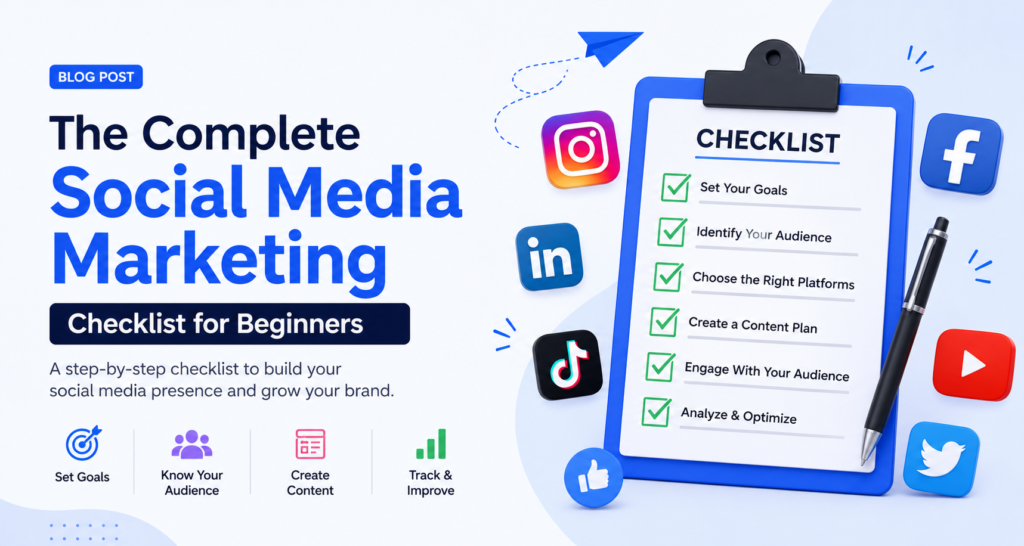
Table of Contents
- Setting Up a Strong Foundation Before You Post Anything
- Choosing the Right Social Media Platforms for Your Business or Brand
- Creating and Optimizing Your Social Media Profiles the Right Way
- Planning and Creating Content That Your Audience Actually Wants to See
- Growing Your Audience and Building Genuine Engagement Over Time
- Managing Your Time and Staying Consistent Without Burning Out
1.Setting Up a Strong Foundation Before You Post Anything
Before you write a single caption or upload a single photo, there is important groundwork to lay. SOCIAL MEADIA MARKETING Most beginners skip this part entirely because it feels slow and unglamorous. That is exactly why most beginners struggle. The people who do this foundational work first are the ones who see steady, real growth while everyone else is guessing.
Defining Your Goals and What You Want to Achieve on Social Media
The first question to ask yourself is not “what should I post?” It is “what am I actually trying to accomplish here?” These are two very different starting points, and confusing them leads to wasted effort.
Identifying Your Target Audience and Understanding What They Need
Here is something that surprises a lot of beginners: the better you understand your audience, the less content you need to create. When you know exactly who you are talking to and what they care about, every post lands more effectively.
Auditing Your Current Online Presence Before Starting Fresh
If you have any existing social media accounts, now is the time to look at them honestly before moving forward.
Checking what content has worked before
If you have been active on any platform, dig into your analytics and look for posts that performed unusually well — more likes, comments, shares, or saves than your average. Ask yourself why those particular posts worked. Was it the topic? The format? The timing? That information is genuinely useful going forward.
If you are starting from zero with no previous content at all, that is completely fine. Your baseline is simply where you are today, and everything you track from here will show real growth.
2. Choosing the Right Social Media Platforms for Your Business or Brand
Understanding the Key Differences Between Major Platforms
Each platform has its own culture, content style, and audience expectations. SOCIAL MEADIA MARKETING Here is a plain-language breakdown of the main ones:
Still the largest social network by user count, with particularly strong reach among adults aged 30 and older. Works well for community groups, local businesses, events, and longer-form content. Organic reach for pages has declined significantly over the years, but groups remain highly engaged spaces.
Primarily visual — photos, short videos (Reels), and Stories. Works best for lifestyle brands, fashion, food, travel, fitness, beauty, and any product or service that photographs well. The audience skews slightly younger than Facebook but covers a wide range of ages.
The professional network. Ideal for B2B companies, consultants, coaches, recruiters, and anyone whose audience makes business decisions. SOCIAL MEADIA MARKETING Text-based posts often perform well here alongside professional articles and industry commentary.
3. Creating and Optimizing Your Social Media Profiles the Right Way
Your profile is your first impression. Someone who finds your SOCIAL MEADIA MARKETING content and clicks through to your profile will decide within a few seconds whether to follow you or not. A poorly set-up profile loses people who were already interested enough to look. That is a frustrating way to miss out on followers you already earned.
Writing a Clear and Accurate Bio or Profile Description
What to include in your bio
A good bio answers three things quickly:
- Who you are or what your business is
- What you offer or what you help people with
- Who specifically you serve
Choosing the Right Profile Images, Cover Photos, and Visual Branding
Why your profile photo matters more than most people think
Your profile photo appears on every comment you leave, every post you publish, and every search result you appear in. It is the visual cue that makes you immediately recognizable. A blurry, SOCIAL MEADIA MARKETING outdated, or poorly cropped photo sends the wrong signal about the care you put into your work.
4. Planning and Creating Content That Your Audience Actually Wants to See
This is the part most people are eager to get to. SOCIAL MEADIA MARKETING And honestly, creating content can be genuinely enjoyable once you have a plan. SOCIAL MEADIA MARKETING Without a plan, it tends to feel like a constant scramble — staring at a blank caption box, SOCIAL MEADIA MARKETING wondering what to post, already running late.
Building a Simple Content Plan and Posting Schedule
How to decide what topics to cover
Start with your audience’s questions. SOCIAL MEADIA MARKETING What do people ask you most often about your product, service, or area of expertise? Those questions are your content ideas. SOCIAL MEADIA MARKETING Every question your customers ask repeatedly is a topic that other potential customers are probably also wondering about.
Writing Captions, Headlines, and Calls to Action That Encourage Engagement
The basic structure of a good caption
SOCIAL MEADIA MARKETING The first one or two lines of your caption are the most important. On most platforms, the rest of the text is hidden behind a “more” button. SOCIAL MEADIA MARKETING If your opening line does not give people a reason to keep reading, they will scroll past.
Good opening lines do one of several things:
- Ask a question that the reader immediately wants to answer
- Make a statement that challenges a common assumption
- Share a surprising fact or counterintuitive idea
- Start a story mid-action so the reader wants to know what happens next
5. Growing Your Audience and Building Genuine Engagement Over Time
Growing on social media is a slow process when you are doing it honestly, and that is actually a good thing. A genuine, engaged audience of 500 people will produce better results for your business than a purchased following of 10,000 inactive accounts.
Strategies for Attracting New Followers Organically
Using hashtags, keywords, and tags correctly
Hashtags and keywords help platforms understand what your content is about and surface it to users who are interested in those topics.
Responding to Comments, Messages, and Mentions to Build Real Connections
Engagement is a two-way conversation
This is something a lot of beginners miss. They focus entirely on creating and publishing content, then treat the comment section as background noise. But the comment section is where community is built.
racking Your Performance and Making Improvements Based on Real Data
Basic metrics every beginner should monitor
You do not need to become a data analyst to use your analytics effectively. Start with these four:
- Reach — How many unique accounts saw your content? This tells you how far your content is spreading.
- Engagement rate — The percentage of people who saw your post and interacted with it (liked, commented, shared, saved). A healthy engagement rate varies by platform and following size, but anything above 3-5% is generally considered solid for most accounts.
- Follower growth — Are you gaining followers consistently over time? Look at the trend rather than obsessing over individual weeks.
- Link clicks or website traffic from social — If driving people to your website is a goal, check how much traffic is actually arriving from your social profiles using Google Analytics or your website platform’s built-in tracking.
6. Managing Your Time and Staying Consistent Without Burning Out
Burnout is real in social media management, SOCIAL MEADIA MARKETING and it happens to a lot of people who start out genuinely enthusiastic. The pressure to post constantly, respond immediately, SOCIAL MEADIA MARKETING and keep up with every trend can become exhausting — especially when you are also trying to run an actual business or do actual work.
Setting Up a Realistic Workflow That Fits Your Schedule
Batch-creating content
SOCIAL MEADIA MARKETING Batch creation means setting aside one or two dedicated sessions per week to create multiple pieces of content at once, SOCIAL MEADIA MARKETING rather than trying to come up with something new to post every single day.
Repurposing Content Across Multiple Platforms to Save Time
Repurposing is one of the highest-value habits you can develop as a content creator. SOCIAL MEADIA MARKETING The idea is that one piece of content, created once, can be adapted into several different formats for different platforms — so you are not starting from zero every time.
How one piece of content can become many:
- A blog post → pull five key points and create an Instagram carousel
- A blog post → record yourself talking through the main ideas and post it as a YouTube video
- A YouTube video → extract the best 60 seconds for a TikTok or Reel
- A YouTube video → pull a compelling quote and turn it into a text graphic for LinkedIn
- A podcast episode → write a caption summarizing the main takeaway for Instagram or Facebook
- A customer question you answered in email → turn it into a text post with your full answer
Knowing When to Ask for Help or Bring in Outside Support
Signs that social media is taking too much of your time
- You are regularly spending more than 15 hours per week on social media content and management
- Social media tasks are regularly displacing revenue-generating work in your schedule
- The quality of your content is declining because you are rushing through it
- You feel consistently stressed, behind, or resentful about posting — even on days when you have nothing urgent to do
Frequently Asked Questions (FAQs)
Most beginners do best starting with just one or two platforms where their target audience is most active. Trying to manage too many accounts at once usually leads to inconsistent posting and low-quality content. Master one platform first, then consider expanding once you have found a rhythm.
Most businesses and creators start seeing meaningful growth after three to six months of consistent effort. Results vary depending on your industry, content quality, posting frequency, and how well you engage with your audience. It is important to be patient and trust the process during the early months, even when progress feels slow.
No. Organic growth is entirely possible, especially in the beginning. Paid advertising can help speed things up later, but it works best when you already have a solid content strategy and a clear understanding of your audience. Building organically first also gives you valuable data about what content resonates before you spend money amplifying it.