
the Local SEO Checklist for Small Businesses in 2026
local seo Somewhere near you, right now, someone is searching for what you sell. A plumber. A dentist. A decent flat white. local seo The only question that matters is whether they find you — or the business two blocks over that actually bothered to fill out its Google profile.
Local SEO has shifted a lot in the last couple of years, and not in small ways. AI Overviews now sit above the map pack. Reviews can be posted anonymously. The list of things Google weighs when deciding who to show has gotten longer and stranger. And yet — the boring stuff still wins. An accurate Google Business Profile, consistent listings, real reviews from real people. That hasn’t changed, and it’s probably not going to.
local seo This is the checklist I’d hand a small business owner who wants to actually show up in 2026, not just check a box and move on.
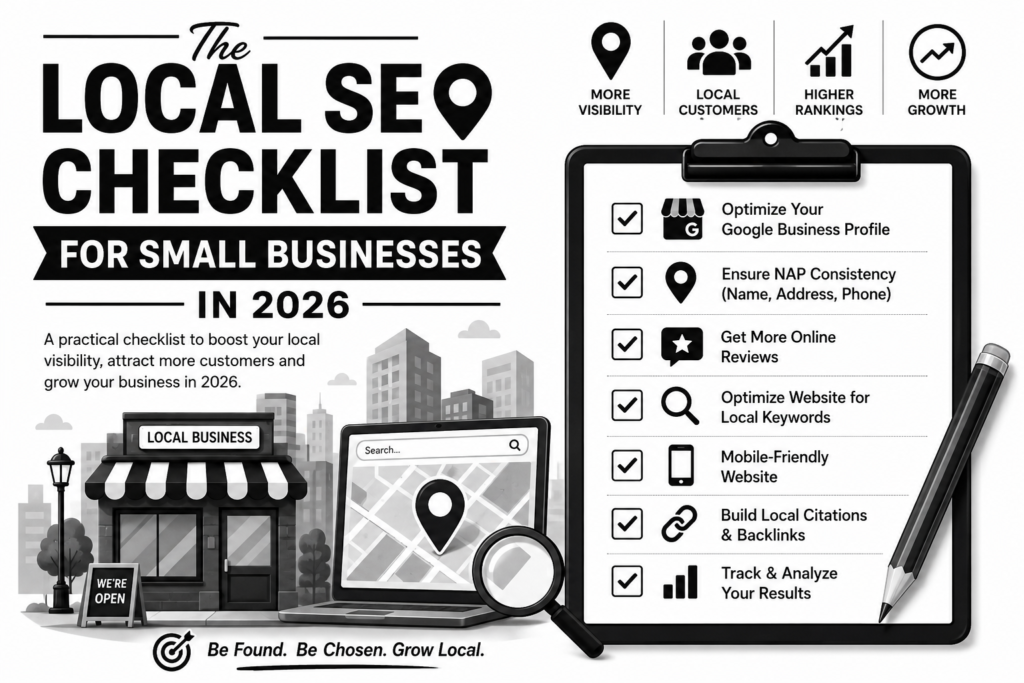
Why local search still matters (maybe more than ever)
Local SEO When someone types “plumber near me” into Google, three things determine who shows up: how relevant you are to the search, how close you are to them, and how much Google trusts that you’re a real, credible business. These aren’t idle searches, either — someone Googling “best coffee shop downtown” at 8:15am is probably ordering within the hour. That immediacy is what makes local search some of the most valuable traffic a small business can get.
What’s genuinely new is how that trust gets calculated. AI-generated summaries are now parked above or alongside the traditional map results for plenty of local queries, and tools like ChatGPT, Gemini, and Perplexity have quietly become part of how people find businesses in the first place. So your checklist now has two audiences: the classic Google algorithm, and the AI systems reading the web on your behalf.
Here’s what to actually do about it.
1. Claim and fully build out your Google Business Profile
Everything else on this list assumes you’ve done this first. local seo If you haven’t claimed your listing, stop and do that before reading any further.
- Claim and verify your listing through Google Business Profile.
- Pick the most accurate primary category — this matters more than people think — then add secondary categories to widen your reach.
- Fill in every field. Hours, service areas, attributes, a real description. Don’t leave gaps.
- Upload real photos — your storefront, your team, your actual work — and keep adding to them over time.
- Post updates or offers regularly through GBP Posts so the listing looks alive.
- Turn on messaging or booking if your business can support it.
- Recheck it monthly. Hours change, phone numbers change, and an outdated listing quietly costs you customers.
Honestly, an incomplete profile is one of the most common — and most fixable — reasons a small business loses ground to a competitor with a fraction of its reputation.
2. Get your NAP consistent everywhere
NAP — Name, Address, Phone number — sounds trivial until you realize search engines use it to cross-check whether your business is legitimate. Inconsistent info reads as a red flag, even when it’s an honest typo.
- Check your NAP on your website, your GBP, and every directory you’re listed on (Yelp, Bing Places, Apple Maps, and whatever’s specific to your industry).
- Fix inconsistencies, even the tiny ones — “St.” versus “Street” can genuinely muddy the signal.
- Use a local phone number rather than a toll-free one if you can.
- Write down the exact, approved format somewhere everyone on your team can find it, so nobody accidentally introduces a new variant six months from now.
3. Build up your local citations
Citations are just mentions of your business elsewhere on the web — directories, local seo chambers of commerce, trade groups, local news. They’re trust signals, and increasingly, AI systems lean on them too.
- Get listed on the major directories (Yelp, Bing Places, Apple Maps) plus whatever’s relevant to your industry specifically.
- Join your local Chamber of Commerce or trade association — often an easy, high-quality citation.
- Look into sponsoring a local school, nonprofit, or community event that comes with a website mention.
- Don’t chase volume. Ten relevant, accurate citations beat fifty scraped from low-quality directories.
4. Stop treating reviews like an afterthought
Local SEO Reviews shape your map pack ranking directly, and Google pays attention to how many you have, how good they are, and how recent. One wrinkle worth knowing about in 2026: Google now lets people leave reviews anonymously, which will likely mean more reviews overall — but also more negative ones from people who feel less accountable for what they say.
- Bake review requests into your actual workflow. Ask right after the job’s done or the sale’s made — not two weeks later when the moment’s gone.
- Spread requests across platforms — Google, Yelp, Facebook, whatever’s specific to your industry — not just Google.
- Respond to everything, good and bad, and do it promptly. People notice how you handle criticism as much as praise.
- Have an actual process for negative reviews instead of reacting in the moment. And never, ever offer incentives for reviews — most platforms will penalize you for it.
- Keep an eye out for sudden spikes in odd or anonymous reviews. That’s a pattern worth investigating, not just individually responding to.
5. Make your website pull its weight
Your GBP does a lot of heavy lifting, but your actual website still matters — both to Google and to anyone who clicks through.
- Use location-specific title tags and meta descriptions on your key pages (“Emergency Plumber in [City] | [Business Name]” beats something generic every time).
- Build separate pages for each service, and separate pages for each area you serve if you cover more than one.
- Embed a Google Map on your contact page.
- Write location-specific alt text on relevant images.
- Put your NAP in the footer, on every page.
- Make sure it’s fast and works well on mobile — most local searches happen on a phone, often from someone standing outside, in a hurry.
- Link your service pages, location pages, and blog posts together in a way that actually makes sense to a reader.
6. Write content that could only be about your business
Generic service pages don’t move the needle much anymore — especially now that AI-written content is everywhere and search local seo engines are visibly rewarding stuff that shows real, specific expertise.
- Write about your actual service area — neighborhood guides, local events, problems that are specific to where you operate.
- Build a real FAQ page around the long-tail questions your customers actually ask (“How much does a water heater replacement cost in [City]?” not “What is a water heater?”).
- Lead with the answer. Question-style headings followed by a direct, clear answer in the first sentence or two tend to perform well both in search and in AI-generated summaries.
- Skip the thin, filler Q&A pages. One page done properly beats ten done halfway.
- Show your work — case studies, before/after photos, actual credentials. This is what search engines mean when they talk about E-E-A-T.
7. Earn backlinks that are actually local
Backlinks are still one of the strongest ranking signals out there, but the bar for “worth having” has gone up. Quality over quantity, more than ever.
- Try to get coverage or mentions from local news outlets, community blogs, or regional publications.
- Sponsor a local event, team, or nonprofit in exchange for a mention on their site.
- Contribute your expertise to a local trade association or partner organization for a natural, editorial link.
- Skip guest-post schemes and bulk directory submissions. One solid local link outperforms a pile of weak ones.
- Even unlinked mentions of your business can help — AI systems tend to look for corroborating mentions across the web, not just clickable links.
8. Add structured data to your site
This one’s more technical, but it’s the difference between being legible to AI systems and being invisible to them. local seo Structured data (schema markup) tells search engines and AI tools exactly what your business is, where it is, and what it does.
- Add LocalBusiness schema with your NAP, hours, and service area.
- Add Review and Service schema wherever it applies.
- Use FAQ schema on pages with genuine, useful Q&A content.
- Run it through Google’s Rich Results Test before you publish, just to be safe.
local seo It’s not glamorous work, but it directly affects your odds of showing up in AI Overviews and similar summaries — which are becoming a real entry point for how people find local businesses now.
9. Get hyper-local (and think about voice search)
The more specific you get, the more of an edge you have over competitors targeting an entire city with nothing more precise than a zip code somewhere in their footer.
- Figure out which neighborhoods or zip codes within your service area actually generate the most business.
- Weave those terms naturally into your service pages and blog content — don’t force it, and definitely don’t stuff it.
- Think about how people phrase voice searches (“Who’s the best electrician near me that’s open right now?”) and write some content that answers questions like that directly.
10. Actually track what matters
Rankings alone can mislead you, especially now that a growing share of conversions happen through calls, GBP local seo interactions, and AI referrals rather than clicks straight to your site.
- Watch calls, form submissions, and direction requests through Google Business Profile Insights.
- Track growth in branded searches over time — it’s a decent proxy for how well-known you’re becoming locally.
- Keep an eye on referral traffic from AI platforms; local seo it often converts better than regular organic traffic.
- Set a monthly rhythm for checking your GBP, citations, reviews, and site performance. local seo This isn’t a set-it-and-forget-it project.
Bringing it all together
Local SEO in 2026 isn’t really about chasing one ranking spot. It’s about becoming the kind of business that Google, Maps, and AI systems trust enough to keep recommending — which means showing up consistently across your profile, your site, your reviews, and your community, all built on information that actually matches up.
None of the individual steps here are hard. What’s hard is doing them consistently — keeping the profile current, earning reviews steadily, local seo writing content that reflects real local knowledge, and actually being part of your community rather than just claiming to be. The businesses that treat this as ongoing maintenance, not a one-time project, are the ones that end up owning their local market.
Work through this list once, local seo then come back to it every few months. Local search rewards the businesses that keep showing up — not the ones who optimize once and disappear.